

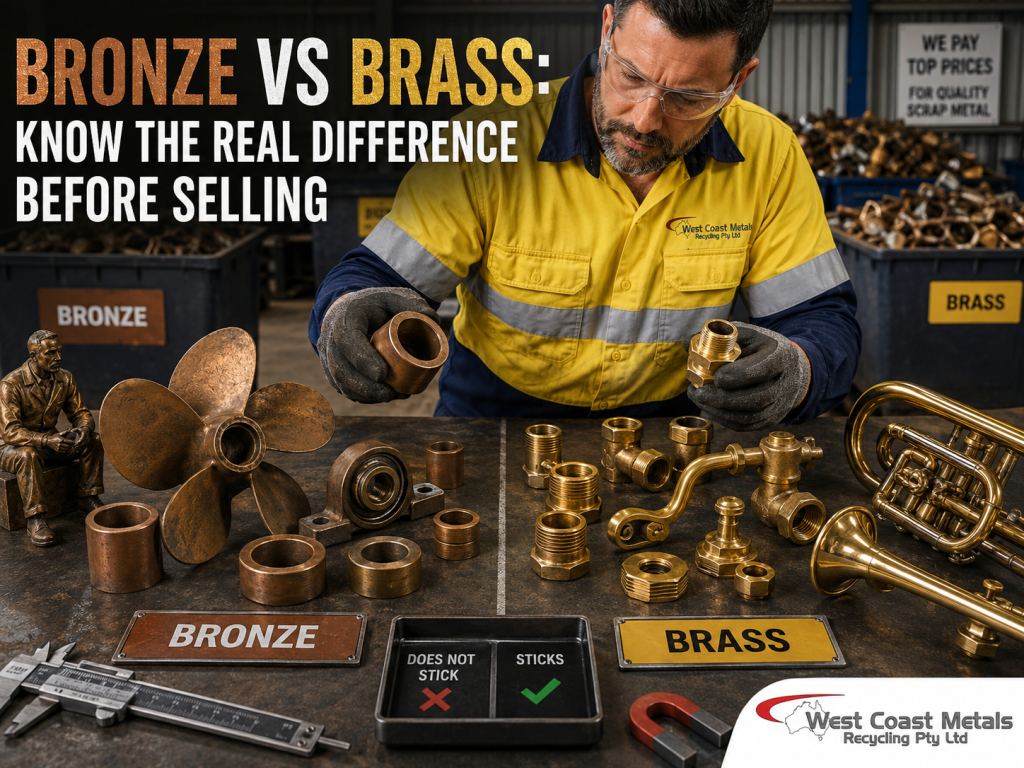
Bronze and brass is a mix-up we see at our Perth scrapyard almost every week, and it costs sellers real money. If you’ve sorted through old plumbing fittings, boat parts, or a box of odd metal offcuts and wondered what you’re actually holding, you’re not alone.
Here’s the answer you’re looking for: Bronze is an alloy of copper and tin, while brass is an alloy of copper and zinc. Bronze usually contains more copper, so it tends to fetch a higher scrap price, though the exact value still depends on purity, grade, and market demand.
This guide covers composition, properties, key differences, how to tell the two apart, real scrap prices, and the applications that give each alloy its value.
As WA’s only female run recycling facility with 38 years in the industry, we’ll show you how to get a fair price once you know what you’re holding.
What Is Bronze? (Key Properties & Composition)
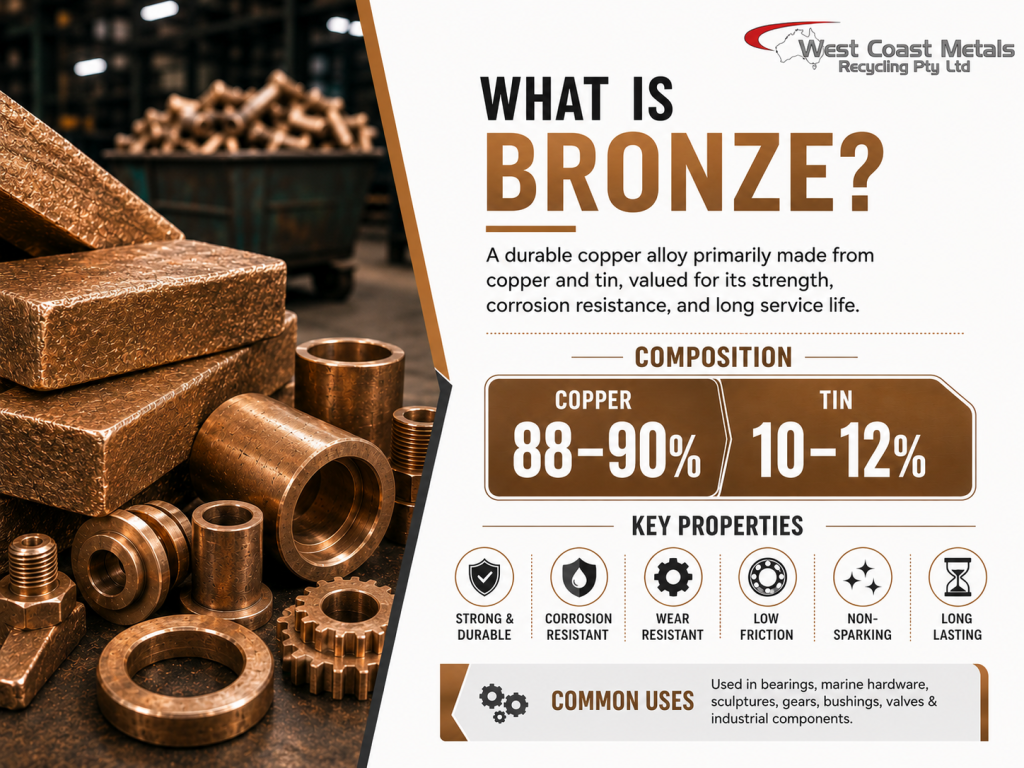
Bronze is a non-ferrous alloy made primarily from copper and tin. Traditional bronze typically contains around 88–90% copper and 10–12% tin, although modern bronze alloys may also include small amounts of aluminium, manganese, phosphorus, silicon or arsenic to improve specific performance characteristics.
Because of its high copper content, bronze is known for its strength, durability and exceptional resistance to corrosion. It has been used for thousands of years in marine, industrial and architectural applications where long service life is essential.
Key Properties of Bronze
Some of the most important key qualities of bronze include:
- Great hardness and great strength
- Great wear resistance
- Low-friction surface great for moving parts
- Great corrosion resistance especially in salt water
- Great resistance to marine environments
- Great fatigue resistance
- Long life span
- Great melting point (approximately 950°C)
- Great non-magnetism
- Recyclable material without losing much value
What Does Bronze Look Like?
Bronze is reddish-brown material with a dull colouration. When it gets older, it acquires dark brown or even green colouration due to protective patina that develops because of exposure to moisture or coast environment.
Pros and Cons of Bronze
Pros:
- High durability
- Good corrosion resistance
- Poor performance in marine environments
- Good resistance to wear and friction
- Long life
- Good recycling possibilities
Cons:
- More expensive than many other copper-based alloys
- Difficult machining as compared to brass
- More brittle in some conditions
- Heavier than brass
What Is Brass? (Key Properties & Composition)
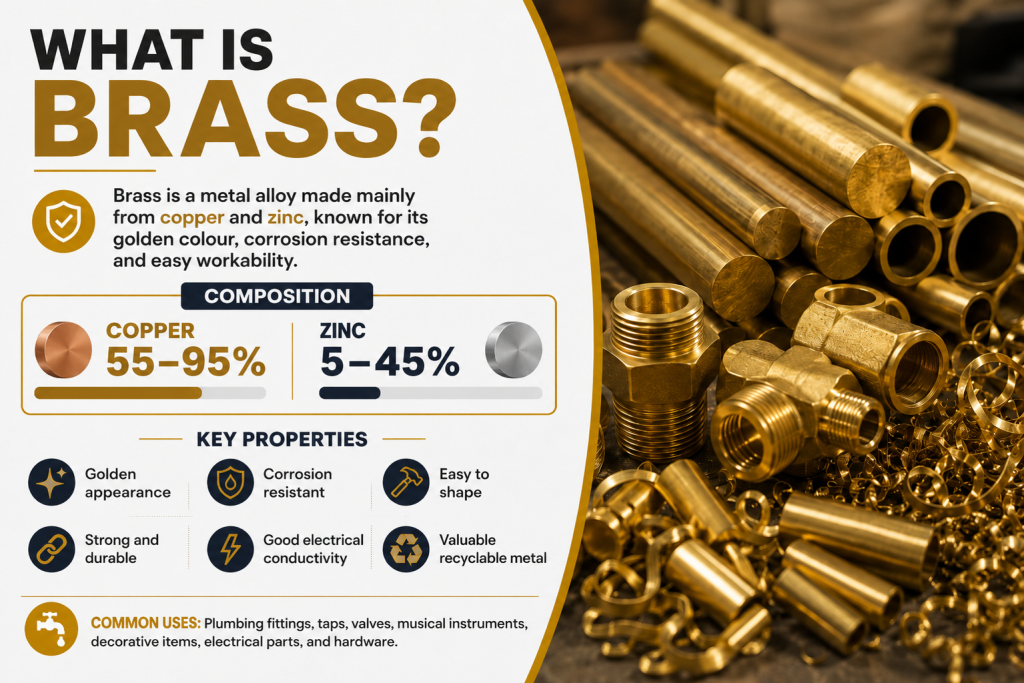
Brass is another non-ferrous alloy, but instead of tin, it is made by combining copper with zinc. Depending on its intended use, brass generally contains 55–95% copper and 5–45% zinc. Some grades may also include small amounts of lead, iron, aluminium or manganese to improve machinability or strength.
Brass’s appealing gold-like colour, good workability, and high corrosion resistance make it one of the most extensively utilised metals around the globe.
Key Properties of Brass
The main characteristics of brass are:
- High malleability
- Easily machinable and formable
- Good castability
- Good corrosion resistance
- Good thermal conductivity
- Good electrical conductivity
- Not magnetic
- Antibacterial properties
- Low melting point (approximately 900°C)
- Bright yellow or golden colour
- Recyclable via brass scrap recycling
How Does Brass Look Like?
In general, brass is a bright golden or yellow metal, but the exact shade will depend on the amount of zinc in the alloy, because more zinc in the alloy produces lighter yellow shade.
Pros and Cons of Brass
Pros:
- Easy to machine and form
- Bright and decorative look
- Affordable compared to bronze
- Excellent electrical and thermal conductivity
- Resistance to corrosion in most conditions
- Highly recyclable
Cons:
- Softer than bronze
- Less resistant to wear
- Prone to discolouration over time
- Overall lower strength than bronze
Bronze vs Brass Metal: Key Differences Explained
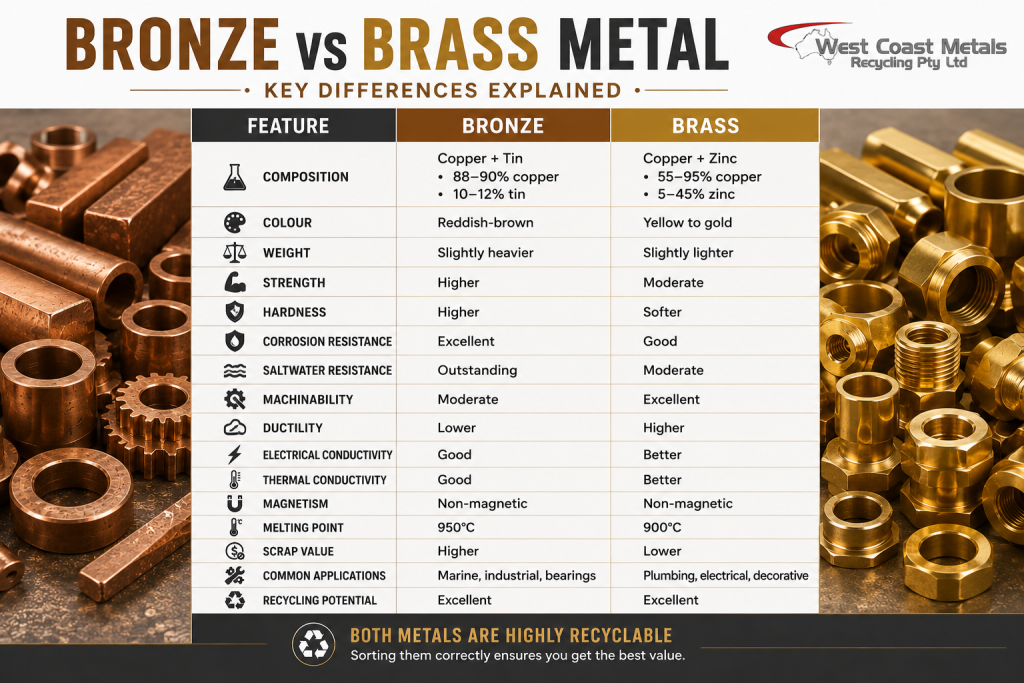
While both are valuable non-ferrous metals, their composition and performance differ in several important ways.
Feature | Bronze | Brass |
Composition | Copper + Tin – 88–90% copper – 10–12% tin | Copper + Zinc – 55–95% copper – 5–45% zinc |
Colour | Reddish-brown | Yellow to gold |
Weight | Slightly heavier | Slightly lighter |
Strength | Higher | Moderate |
Hardness | Higher | Softer |
Corrosion Resistance | Excellent | Good |
Saltwater Resistance | Outstanding | Moderate |
Machinability | Moderate | Excellent |
Ductility | Lower | Higher |
Electrical Conductivity | Good | Better |
Thermal Conductivity | Good | Better |
Magnetism | Non-magnetic | Non-magnetic |
Melting Point | 950°C | 900°C |
Scrap Value | Higher | Lower |
Common Applications | Marine, industrial, bearings | Plumbing, electrical, decorative |
Recycling Potential | Excellent | Excellent |
Understanding these differences is useful, but identifying your own scrap correctly is even more valuable before visiting a scrap metal Perth recycler.
How to Identify Bronze vs Brass Before You Sell as Scrap
Proper determination of whether the metal to be sold at the scrapyard is bronze or brass can ensure that you get a better deal and guarantee proper recycling of your scrap. While both these metals belong to non-ferrous copper alloys which have monetary value, they have different properties. There are some easy ways of determining which is which.
5 Simple Ways to Identify Bronze and Brass
1- Compare the Colour
Colour is usually the quickest clue.
➙ Bronze has a darker reddish-brown appearance.
➙ Brass has a brighter yellow or gold-like finish.
2- Try a Magnet Test
Neither bronze nor brass is magnetic.
If your metal sticks firmly to a magnet, it’s likely steel, iron or another ferrous metal rather than solid bronze or brass. Keep in mind that some items may contain steel screws or attachments, so check the metal itself.
3- Perform a Scratch Test
Bronze is naturally harder than brass.
➙ Bronze is more difficult to scratch.
➙ Brass scratches more easily because it’s softer and more malleable.
4- Listen to the Sound
Lightly tap the metal with another metal object.
➙ Bronze produces a deeper, more muted sound.
➙ Brass creates a brighter, higher-pitched ringing tone.
5- Consider Where the Metal Came From
The source of the metal can be one of the easiest ways to determine what type of metal you have. There are various uses for bronze and brass within certain industries due to their individual characteristics.
Bronze is commonly found in:
- Marine equipment and propellers on boats
- Bearings and bushings
- Industrial equipment
- Sculptures and statues
- Bells and cymbals
Brass is commonly found in:
- Plumbing pipe
- Tapware and valves
- Door handles and locks
- Electrical connections
- Music instruments
- Furniture fixtures
Bronze vs Brass Identification at a Glance
Identification Method | Bronze | Brass |
Colour | Reddish-brown | Bright yellow or gold |
Scratch Test | Harder to scratch | Softer and scratches more easily |
Sound Test | Deep, dull tone | Clearer ringing sound |
Weight | Generally, feels heavier | Slightly lighter |
Magnet Test | Non-magnetic | Non-magnetic |
Common Uses | Bearings, marine fittings, statues | Pipes, taps, locks, musical instruments |
If you are still unsure whether you have found a piece of bronze or brass metal, that’s ok. Bring it into West Coast Metals and we will sort it out for you, tell you about the grading process, and how we can make the most of your scrap over a cup of coffee.
Bronze Applications vs Brass Applications
The choice between bronze and brass will be determined by the surrounding, strength needs, and usage purpose. Although the two metals are equally versatile copper alloys, each has its own strength in different applications.
Common Applications of Bronze
Bronze is favoured where longevity, minimal friction, and corrosion resistance are key. The common bronze applications are:
- Bearings and bushes
- Marine equipment, like propellers and ships fittings
- Components of pumps and valves
- Gears and machinery parts
- Springs
- Industrial wear plates
- Tools that do not cause sparks
- Sculptures and statues
- Bells and cymbals
- Architectural parts
- Precision engineering parts
- Electrical connectors for specific applications
Common Applications of Brass
Brass is valued for its workability, conductivity and attractive appearance. Popular brass applications include:
- Plumbing fittings, taps and valves
- Door handles, locks and hinges
- Musical instruments
- Electrical terminals and connectors
- Decorative fixtures
- Radiators and heat exchangers
- Bearings and light-duty gears
- Ammunition casings
- Coins
- Jewellery
- Fasteners
- Home décor and architectural hardware
Understanding where these metals are commonly used can also help you identify your scrap before visiting a scrap metal Perth recycler.
Bronze vs Brass Scrap Prices in Perth (2026)
Many people search for brass price per tonne Australia, some search for brass scrap price, brass junk price or bronze junk price, but scrap values change daily with global copper markets, alloy composition and local demand.
The table below shows indicative market ranges only.
Metal | Indicative Price (Per Tonne) |
Clean Brass | $6,000–$9,000 |
Clean Bronze | $3,000–$6,500 |
Indicative only. Actual prices vary depending on market conditions, alloy grade, contamination, quantity and current demand.
What Affects Metal Scrap Value?
The worth is influenced by various elements like:
- Copper content
- Grade of alloy
- Pure metals vs contaminated metals
- Volume/quantity of supply
- Retail price of international copper
- Recycling demand of your area
When there is a combination of brass and bronze, the scrap will require sorting again and it may have more value of low-quality scrap.
Preparing Bronze and Brass for Sale
A little preparation can help maximise the value of your scrap.
- Sort your metals. Keep bronze and brass separate whenever possible.
- Remove attachments. Strip away steel, rubber, plastic or other non-metal components.
- Clean the material. Cleaner scrap is quicker to process and easier to grade.
- Sell larger quantities together. Bulk loads are generally more efficient to assess and process.
Proper preparation also speeds up unloading and helps your recycler provide a more accurate assessment.
Why Sorting Bronze and Brass Matters When You Sell
In order to process any mixed material in the recycling yard, every item needs to be sorted and inspected before it can get into the recycling process. This slows down the process and lowers the value of the total batch if different alloys are difficult to distinguish.
By sorting out your bronze from your brass prior to delivery, you speed up the grading process and maximize your chance of getting a proper price on the market.
Turn Your Bronze or Brass into Cash at West Coat Metal
If you’re looking for trusted metal recycling Perth services or reliable scrap metal yards Perth, West Coast Metals offers more than just competitive prices.
Let nothing get in the way of the maximum value of your scrap; even mixing up metals or wrong classification.
No matter whether you are a private individual or business owner of the home, tradesman, industry or mining company, West Coast Metals makes bronze and brass metal recycling easy and profitable. We will classify your metals and provide a competitive pricing based on our customer-oriented service approach.
When it comes to copper and copper alloys, including some kinds of brass, identification rules do apply. We will be happy to tell you about 100-point ID requirements and answer any questions before you sell.
FAQs
- Is bronze more valuable than brass as scrap?
In many instances, yes. Bronze tends to have more copper than brass. Nonetheless, prices can change on a daily basis depending on the state of the market.
- Can I sell mixed bronze and brass together?
Yes, but separating them first will give you a better valuation.
- What ID do I need to sell brass or bronze in Perth?
The form of identification required is dependent on the item being sold. In some cases, one must have a valid driver’s license and other forms of identification to comply with the law.
- Are bronze and brass weldable?
Yes. Both alloys can be welded using appropriate techniques, although bronze is generally more challenging due to its composition.
- Is brass magnetic?
No. Brass is naturally non-magnetic.
- Is bronze magnetic?
No. Bronze doesn’t attract magnet.
- Can brass and bronze be recycled together?
Both materials are recyclable, but it is recommended that you sort them out since they are two different alloys with different recycling prices.
- How do I tell if my scrap is brass or bronze?
Check the colour, weight, hardness and where the item came from. Brass is mostly yellow or gold-colored whereas bronze is reddish-brown.
- Does brass tarnish?
Yes, brass tends to become dark but is easily polished back into its original condition.
- Does bronze corrode?
Bronze is known for high corrosion resistance; it does not rust but acquires protective layer of green or brown colour.
- Which metal lasts longer outdoors, brass or bronze?
Bronze has higher durability and corrosion resistance making it more suitable for outdoor use.
- Where can I sell bronze and brass scrap in Perth?
Find a trustworthy scrap metal buyer in Perth who will grade your metal properly, pay you fair price and give professional assistance. West Coast Metals buys and recycles a variety of non-ferrous metals responsibly.