

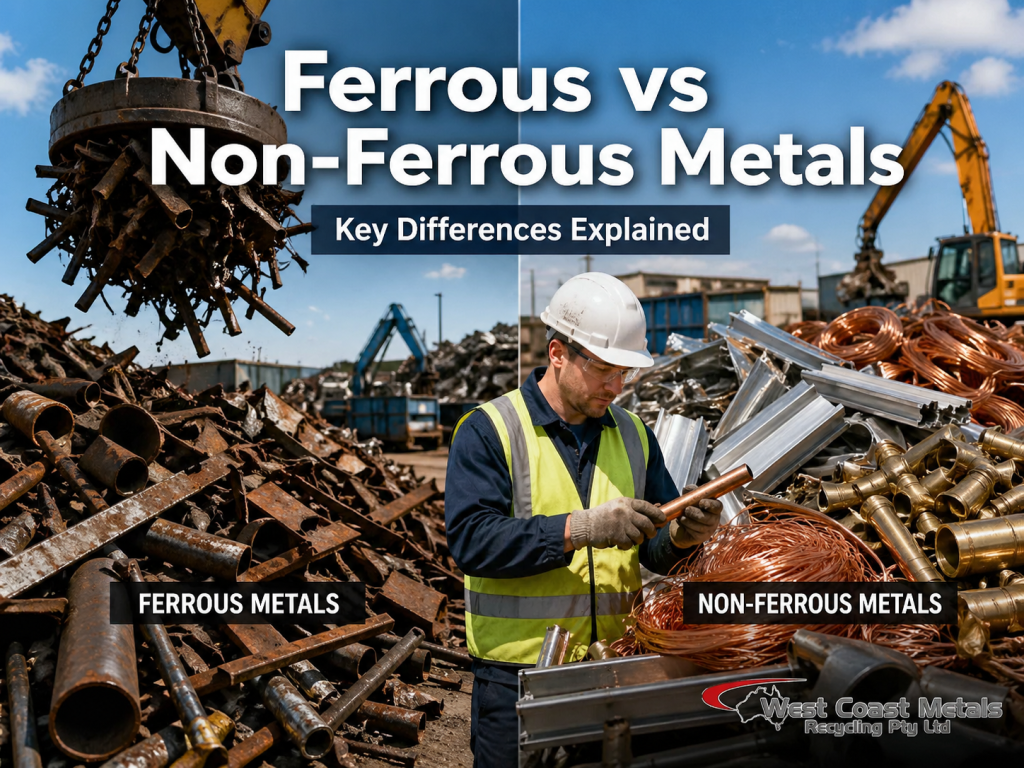
You’ve got a trailer loaded with old pipes, pile a of copper wiring stripped from a renovation, and a heap of steel offcuts from the workshop. Before you drive to the scrapyard, one question matters more than you realise: Which of those metals is actually worth good money, and which is worth just a fraction?
The answer comes down to a simple distinction:
Ferrous metals contain iron which makes them magnetic and prone to rust. Non-ferrous metals contain no significant iron, which makes them non-magnetic, corrosion-resistant, and generally worth more at a Perth scrapyard.
So that one difference determines how magnetic, rust-prone, and valuable your metal is. In Perth’s scrap metal market, knowing the difference between ferrous and non-ferrous metals can genuinely put more cash for scrap in your pocket.
This guide helps you learn what each metal type is, how to tell them apart, what they’re worth in Perth, and how to get the best price when you recycling scrap metal in Perth.
What Are Ferrous Metals?
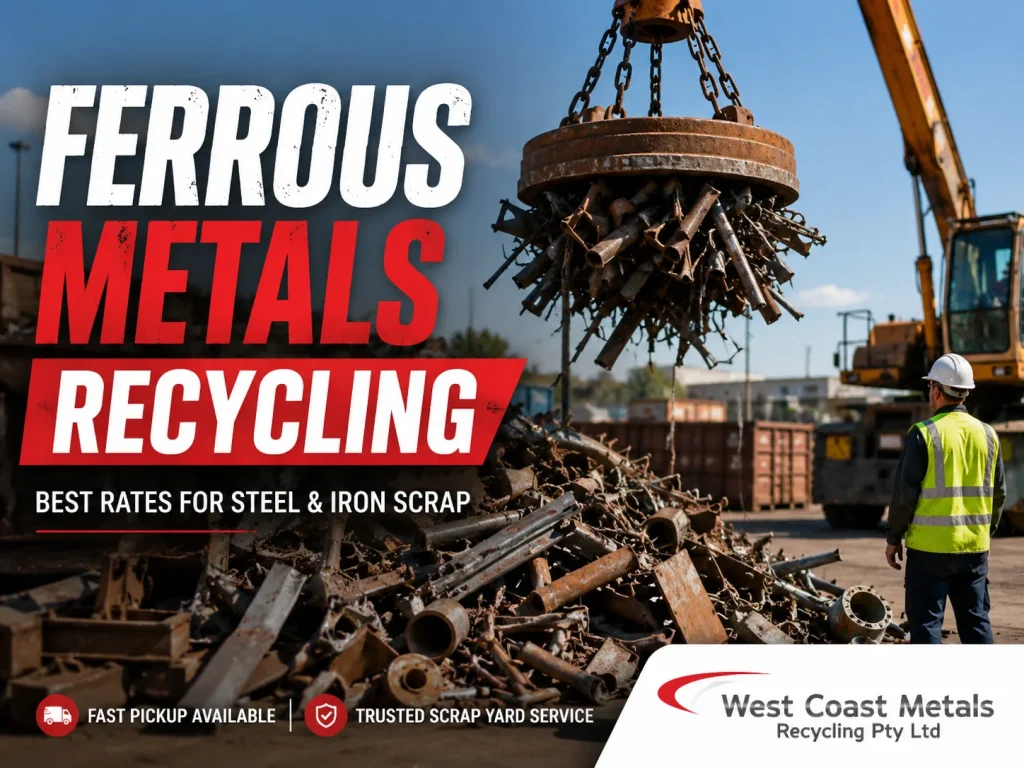
The word “ferrous” comes from the Latin ferrum, which means iron. Ferrous metals are metals that contain iron as a major part of their composition and has magnetic properties. That iron content gives them characteristics like they are strong, heavy, durable, and magnetic. This strength and toughness make them the backbone of major industries like manufacturing, mining, construction, transport, and infrastructure.
Ferrous metals include all forms of iron and steel. In many cases, small amounts of other elements is added to improve certain properties. For example, chromium improves corrosion resistance when added to stainless steel.
Moreover, iron content makes them more prone to rust and corrosion. Many ferrous metals oxidise and rust if exposed to moisture and oxygen over time. But there are two major exceptions: Wrought iron does not corrode as easily due to its high purity level. Plus, stainless steel resists corrosion due to chromium in it.
Key Properties of Ferrous Metals:
- Tough and durable, withstands shock well.
- High magnetic conductivity
- Vulnerable to rusting and corrosion, except for two instances
- Heavy, when compared with non-ferrous metals
- Less scrap value than non-ferrous metals
Common Ferrous Metals:
➙ Alloy steel: It is strengthened with other elements for industrial and engineering uses
➙ Mild steel: It is the most recycled material worldwide, mainly for use in frames, beams, and structures
➙ Cast iron: This includes ancient equipment, engine castings, pipes, and pots
➙ Wrought iron: This includes fences, gates, and artistic metalwork. It resists rusting naturally, because of its purity.
➙ Carbon steel: It is used for making implements, automotive parts, and structures; it rusts easily
➙ Stainless steel: It has chromium which prevents it from corroding. It is still ferrous and recyclable
Common sources of ferrous scrap in Perth include:
- Structural steel beams from demolition sites
- Old roofing iron
- Car bodies (terms and conditions apply)
- Farm machinery
- Industrial equipment
All of these are accepted at West Coast Metals.
Now that you understand ferrous metals, let’s look at their counterpart; non-ferrous metals. Let’s see why they tend to be worth considerably more at a scrapyard.
What Are Non-Ferrous Metals?
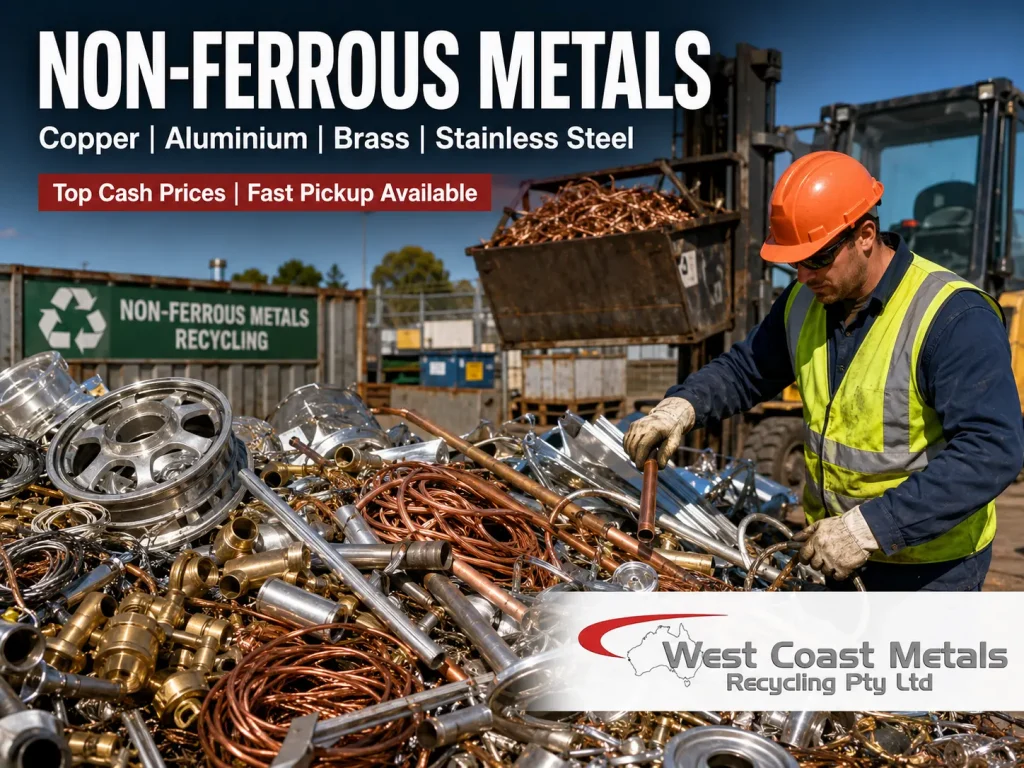
Non-ferrous metals are metals that contain no significant amount of iron. Without iron in the equation, these metals behave very differently like they don’t rust, they aren’t attracted to magnets, they tend to be lighter, and they are far more conductive; both electrically and thermally. These properties make them essential in a huge range of modern applications, from electrical wiring to aircraft manufacturing.
For Perth scrap metal customers, non-ferrous metals are the ones to get excited about. Copper, aluminium, and brass all command significantly higher prices than steel or iron, and many Perth households and tradies have far more of these metals lying around than they realise.
Key Properties of Non-Ferrous Metals:
- Do not contain significant iron; therefore non-magnetic
- Resistant to rust and corrosion
- Lighter than ferrous metals
- High electrical and thermal conductivity
- Higher scrap value per kilogram
- Infinitely recyclable without loss of quality
Common Non-Ferrous Metals:
➙ Copper: Plumbing pipes, electrical wiring, motor windings, air conditioning systems
➙ Aluminium: Window frames, door frames, cans, air conditioning units, roof sheets
➙ Brass: Taps, fittings, valves, radiators, musical instruments
➙ Bronze: Marine fittings, bearings, decorative hardware
➙ Lead: Old car batteries, flashing, old pipes
➙ Zinc: Galvanised steel coatings, die-cast components
➙ Titanium and Nickel: High-performance industrial and aerospace components
Precious metals like gold, silver, and platinum are also non-ferrous, though these are rarely part of a typical scrap metal transaction.
It’s worth noting that some alloys are made from a mix of both types. For example, bronze is an alloy of copper and tin (both non-ferrous). It displays the corrosion resistance and conductivity typical of non-ferrous metals.
So now you know what each category looks like. The next question is: how do you tell them apart when you’re standing in your shed staring at a pile of mixed metal?
Ferrous vs Non-Ferrous Metals: Key Differences
Property | Ferrous Metals | Non-Ferrous Metals |
Contains iron? | Yes | No |
Magnetic? | Yes (mostly) | No |
Rust / Corrosion | Susceptible | Resistant |
Weight | Heavier | Lighter |
Electrical conductivity | Lower | Higher (esp. copper, aluminium) |
Scrap value (per kg) | Lower | Higher |
Common examples | Steel, cast iron, wrought iron | Copper, aluminium, brass, bronze |
The most commercially important difference for Perth scrap metal customers is value.
Non-ferrous metals consistently pay more per kilogram than ferrous metals, sometimes by a factor of ten or more. Knowing what you have before you arrive at the scrapyard means you can ask for accurate, separated pricing rather than a mixed average.
But how do you actually identify which is which without specialist equipment? There’s one easy method almost everyone can use.
The Magnet Test: How to Identify Ferrous and Non-Ferrous Metals at Home
You don’t need a lab to figure out what metal you’re dealing with. The magnet test is the quickest, easiest, and most reliable method available to anyone. All it takes is a standard fridge magnet.
Here’s how magnet test works:
➢ Hold the magnet against the metal.
➢ Magnet sticks firmly? It’s ferrous (contains iron). Think steel beams, cast iron pipes, old car parts.
➢ Magnet doesn’t stick? It’s likely non-ferrous. Think copper pipes, aluminium window frames, brass fittings.
Walk through your shed and try it on everything.
- Old fence posts? Ferrous.
- Copper hot water cylinder? Non-ferrous.
- Aluminium door frames? Non-ferrous.
- Mixed load of offcuts from a reno? Likely a mix of both.
One important exception:
Some grades of stainless steel are weakly magnetic, even though stainless steel is technically ferrous (it contains iron and chromium). If your magnet clings faintly but not firmly, you’re likely dealing with stainless steel. It is still valuable scrap and widely accepted at Perth scrapyards.
Pro Tip: Sort Before You Arrive
Separating your ferrous and non-ferrous metals before you turn up at the scrapyard means faster processing and a cleaner price for each metal type. Mixed loads still get sorted, but pre-sorted loads get processed faster and more accurately.
With your metals identified and sorted, the next natural question is: what are they actually worth?
Which Scrap Metal Is Worth More – Ferrous or Non-Ferrous?
Non-ferrous metals pay far higher rates compared to ferrous metals, usually by a wide margin.
Why do non-ferrous metals have a higher value? Because:
➢ They occur less frequently in nature as compared to iron-based metals
➢ More energy and expense are required to extract and refine them from ore
➢ They are extensively used in electronics, building, and manufacturing industries
➢ Recycled non-ferrous metal can be substituted directly for fresh ore
As a rough estimate of scrap metal prices in Perth for 2026:
Metal | Metal Scrap Price |
Copper (non-ferrous) | $7,000-$10,000 per tonne |
Steel (ferrous) | $100-$300 per tonne |
Aluminium (non-ferrous) | $1,000-$1,500 per tonne |
Brass (non-ferrous) | $3,500-$10,000 per tonne |
Lead (non-ferrous) | $1,000-$4,000 per tonne |
Note: Prices of scrap metal change every day depending on worldwide commodities markets, especially the London Metal Exchange (LME). Always check current pricing with your local Perth scrapyard on the day.
For updated rates and local Perth pricing, read our guide on scrap metal prices.
So, even a modest amount of copper plumbing, a few brass fittings, or some aluminium from an old air conditioning unit can add up to real money. The key is separating your metals so that each type gets its own accurate, fair price.
At West Coast Metals, our team separates your plumbing copper, brass fittings, and aluminium on the spot, so you receive a clean price for each metal type rather than a blended average that often undervalues your high-grade materials.
Important: Under WA regulations, selling copper or copper alloys requires a current driver’s licence and a utility bill no older than 3 months. These two documents together meet the 100-point ID requirement. If you have any questions about this, contact West Coast Metals before your visit.
Where Are Ferrous and Non-Ferrous Metals Used in Perth?
Perth’s economy is heavily shaped by mining, construction, and residential development — all of which generate significant volumes of both ferrous and non-ferrous scrap metal. Understanding where these metals are typically found helps you identify what you might already have on hand.
Ferrous Metals in Perth – Where to Find Them:
➢ Construction and demolition: structural steel beams, RSJs, reinforcing bar (rebar), steel roofing
➢ Mining and heavy industry: old machinery, mining equipment frames, conveyor components
➢ Residential: old fencing, corrugated roofing iron, steel gates
➢ Automotive: car bodies and chassis (terms and conditions apply at most scrapyards)
➢ Industrial: factory plant, old tanks, steel shelving
Non-Ferrous Metals in Perth – Where to Find Them:
➢ Plumbing: copper pipes, brass taps, valves, and fittings from residential or commercial renovations
➢ Electrical: copper wiring, motor windings, transformer cores
➢ Air conditioning: aluminium fins and coils, copper refrigerant lines, compressors
➢ Automotive: aluminium radiators, brass radiators, catalytic converters, starter motors
➢ Construction: aluminium window frames, door frames, extrusions
➢ E-waste: power tools, electric motors, circuit boards containing copper and aluminium
➢ Marine: bronze fittings, nickel components, marine-grade aluminium
Whether you’re a plumber clearing a reno site, a sparky with a bin full of old cable, a mining contractor with decommissioned equipment, or simply a Perth homeowner clearing out the shed, there’s very likely valuable scrap on your hands. And it’s all recyclable.
Why Recycling Ferrous and Non-Ferrous Metals Matters
Scrap metal recycling isn’t just about getting paid. Though that’s certainly a welcome outcome. It’s one of the most energy-efficient and environmentally significant forms of recycling available. Both ferrous and non-ferrous metals can be recycled endlessly without any degradation in their properties. And they remain among the most sustainable substances available on earth.
The environmental case is compelling:
➙ Recycling aluminum requires only 5% of the energy needed to manufacture new aluminum from bauxite ore – a 95% energy reduction.
➙ Recycling steel saves about 60% of energy compared to the extraction of new steel from iron ore.
➙ Metal recycling prevents waste in landfills, greenhouse gases, and the negative effects associated with mining.
The Australian metal recycling industry is huge considering its importance. Based on national statistics, an average of 5.7 million metric tons of metal waste is produced annually in Australia. Of all the waste, around 87% is collected and recycled.
The Australian scrap metal industry is worth $4.5 billion by recent research analysis.
Every time metal is recycled and not thrown away as waste, that’s one step closer to building a true circular economy. Everyone who brings their scrap metal to an ethical Perth scrapyard makes that possible.
What Ferrous and Non-Ferrous Metals Does West Coast Metals Accept?
We accept most of the scrap metals in Perth. Our yard is clean, organised, and built around giving you the best possible outcome, which means sorting and processing your metal on the spot, accurately and fairly.
Ferrous Metals We Accept | Non-Ferrous Metals We Accept |
|
|
We pay cash for scrap metal or bank transfer. For large loads, we offer a free drop-off bin service (terms and conditions apply). Our team unload, sort, and process your metal on the spot so you get the most accurate and fair price possible. Plumbing copper and brass are separated quickly and efficiently so you receive a clean price for each type.
Got scrap sitting in your shed, and no idea what it’s worth?
Bring Your Load to West Coast Metals – Turn Your Scrap Metal into Cash Today
West Coast Metals is Perth’s family-owned, female-run scrapyard with over 20 years of experience serving domestic, commercial, mining, and industrial customers.
Now that you know the difference between ferrous and non-ferrous metals, you’re already ahead of most people who turn up at the scrapyard. Contact us today. Our team will sort, process, and pay you on the spot, in cash or via bank transfer. For large loads, ask about our free drop-off bin service (T&Cs apply).
FAQs About Ferrous and Non-Ferrous Metals
Q1: What is the difference between ferrous and non-ferrous metals?
Ferrous metals contain iron; non-ferrous metals do not. This difference gives them distinct properties. Like ferrous metals are magnetic and prone to rust, while non-ferrous metals are non-magnetic, corrosion-resistant, and generally more valuable per kilogram. Steel and cast iron are common ferrous metals, while copper, aluminium, and brass are common non-ferrous metals.
Q2: Which type of scrap metal pays more – ferrous or non-ferrous?
Non-ferrous scrap metals always cost more compared to ferrous scrap metals. For example, copper scrap pays between $7,000-$10,000 per tonne. Aluminum scrap fetches you around $1,000-$1,500 per tonne and steel mixed scrap around $200-$300 per tonne. Prices tend to change every day, so contact your local scrapyard for current pricing.
Q3: Is stainless steel ferrous or non-ferrous?
Stainless steel is ferrous. It contains iron. However, its high chromium content (at least 10.5%) makes it corrosion-resistant, unlike most other ferrous metals. Some grades of stainless steel are weakly magnetic. It is still a valuable scrap metal accepted at Perth scrapyards including West Coast Metals.
Q4: How to know if my scrap metal is ferrous or non-ferrous?
Magnet test is the simplest way to identify them. Place an ordinary magnet close to the metal. If it holds on to the surface firmly, it is ferrous (containing iron). Otherwise, the metal is likely non-ferrous.
Q5: Do I need ID to sell scrap metal in Perth?
When selling scrap metal in Perth, you need to provide your driver’s license along with a utility bill that is not more than 3 months old. These two documents together meet the 100-point identification requirement under Western Australian regulations.
Q6: What is the magnet test for scrap metal?
The magnet test is the easiest method of differentiating between ferrous and non-ferrous metals at home. Just place a normal magnet on the scrap metals you have. If the magnet attaches itself to the scrap, it is a ferrous metal that contains iron (such as steel and cast iron). On the other hand, if the magnet does not attach itself to the metal, it is a non-ferrous metal.
Q7: Can I recycle both ferrous and non-ferrous metals in Perth?
West Coast Metals accept all kinds of ferrous and non-ferrous scrap metals. These metals include structural steel, cast iron, copper, aluminium, brass, lead, titanium, electronic waste, and others